I was asked by your teacher Ms Baker to talk to you about my experiences of being a scientist. One of the biggest perks of being a scientist is that you can choose to work on something you are interested in. Also, it helps a lot that I can choose when I want to work....
Read more »
Posted in AP Biology, Genetics | View Comments

Note from Ms. Baker: This summer, I’m working in the Nitabach Lab in the Department of Molecular and Cellular Biology at Yale as part of a NIH grant. My goal is to create an AP Biology-level lab curriculum that uses Drosophilia to teach students concepts related to classical & modern genetics, physiology, and animal...
Read more »
Posted in AP Biology, Genetics | View Comments
Regulation is the adaption of form of an organism or a particular system. Our bodies as well as our environments undergo regulation all the time. Regulation is a major component of all life functions. Regulation occurs at the molecular, cellular, and organismal levels, as well as to populations, communities, and biospheres. Regulation is a process...
Read more »
Posted in AP Biology, Themes in Biology | View Comments
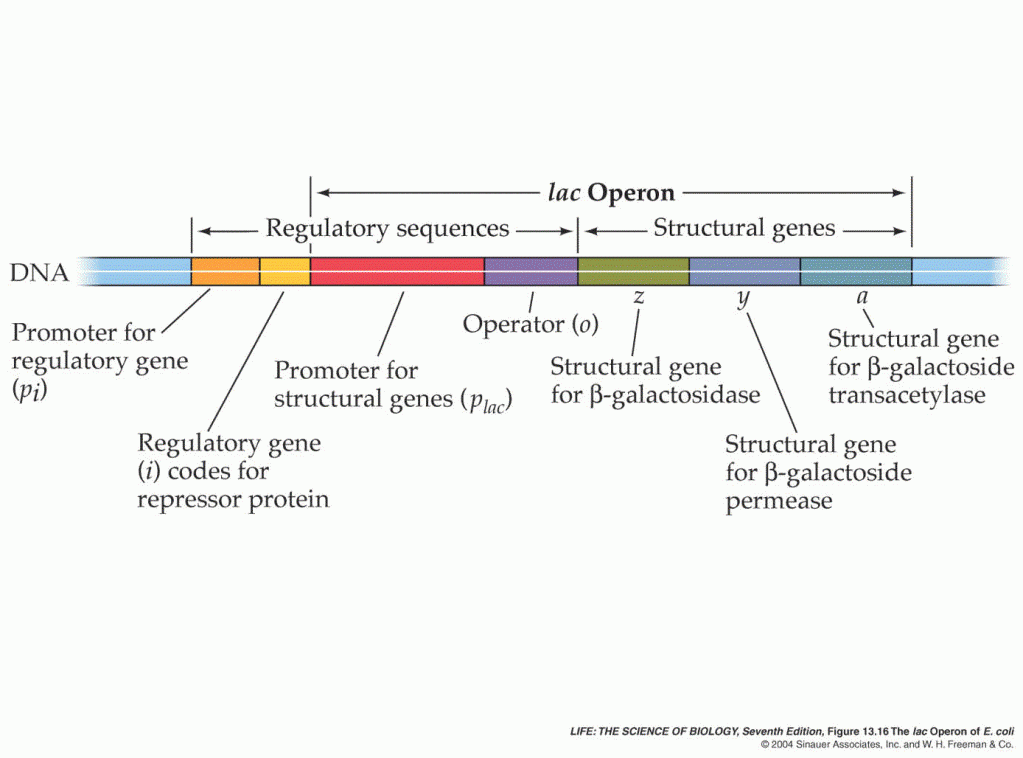
Regulation, by definition, is the adaptation of form or behavior of an organism to changed conditions. Molecular Level – Operon The operon is a region of bacterial DNA that regulates gene expression in bacteria. The operon consists of four major parts: structural genes, regulatory gene, the promoter gene, and the operator. Structural genes are...
Read more »
Posted in AP Biology, Themes in Biology | View Comments
Science is a process which encompasses many methods in order to reach a final conclusion. An inference is defined as the reasoning involved in drawing a conclusion or making a logical judgment on the basis of circumstantial evidence and prior conclusions. Inference is a key part of the process of science. Much of the...
Read more »
Posted in AP Biology, Themes in Biology | View Comments

This post was originally published on January 22, 2009. by Rose Hi everybody! Wow… It’s been a while since my last blog post – I can’t believe it’s already been almost two years since I took AP Bio! It feels quite surreal writing this post as a college student. First, to introduce myself:...
Read more »
Posted in AP Biology | View Comments

by Stephen In a nut shell, sexual reproduction increases genetic variation and allows organisms to evolve in changing environments by pairing beneficial traits together which would in turn get passed on to subsequent generations and to do away with harmful variations. Asexual reproducing organisms create exact replicas and in theory would be unable to...
Read more »
Posted in AP Biology | View Comments

by Curtis Not too many people ever think about the multitude of diseases which may be lurking in that piece of chicken you just sat down to. However; it may be wise to think about it because a new study has found that around 40 billion commercial chickens may be carrying or susceptible to...
Read more »
Posted in AP Biology, Medicine | View Comments

Evolution is arguably the most central theme in biology because it ties all other major themes together. Evolution is defined as a change in alleles in a population over time. In each level of life, there is evidence of evolution on a population through natural selection on individuals. Darwin, credited as the founder of...
Read more »
Posted in AP Biology, Themes in Biology | View Comments

by Lauren K Next time you’re about to get a lecture about your grades, try blaming it on your genes! An old study of inherited intelligence of fraternal and identical twins has brought to light how much of your intelligence is due to genetics and the environment. Surprisingly, the study of inherited intelligence isn’t...
Read more »
Posted in AP Biology | View Comments